

Location: United States
Member Since:
Aug. 10, 2010
59 readers have added this author as a 'Favorite Author'.



Gerald M. Weinberg
Biography
Gerald M. Weinberg (Jerry) writes "nerd novels," such as The Aremac Project, Aremac Power, First Stringers, Second Stringers, The Hands of God, Freshman Murders, and Mistress of Molecules—about how brilliant people produce quality work. His novels may be found as eBooks at or on Kindle. Before taking up his science fiction career, he published books on human behavior, including Weinberg on Writing: The Fieldstone Method, The Psychology of Computer Programming, Perfect Software and Other Fallacies, and an Introduction to General Systems Thinking. He also wrote books on leadership including Becoming a Technical Leader, The Secrets of Consulting (Foreword by Virginia Satir), More Secrets of Consulting, and the four-volume Quality Software Management series. He incorporates his knowledge of science, engineering, and human behavior into all of writing and consulting work (with writers, hi-tech researchers, and software engineers). Early in his career, he was the architect for the Mercury Project's space tracking network and designer of the world's first multiprogrammed operating system. Winner of the Warnier Prize and the Stevens Award for his writing on software quality, he is also a charter member of the Computing Hall of Fame in San Diego and the University of Nebraska Hall of Fame. The book, The Gift of Time (Fiona Charles, ed.) honors his work for his 75th birthday. His website and blogs may be found at http://www.geraldmweinberg.com.
Smashwords Interview
Where to find Gerald M. Weinberg online
Website: http://www.geraldmweinberg.com
Twitter: @jerryweinberg
Facebook: Facebook profile
LinkedIn: http://www.linkedin.com/pub/jerry-weinberg/6/146/916
Blog: http://secretsofconsulting.blogspot.com/
Twitter: @jerryweinberg
Facebook: Facebook profile
LinkedIn: http://www.linkedin.com/pub/jerry-weinberg/6/146/916
Blog: http://secretsofconsulting.blogspot.com/
Where to buy in print
Videos
The Myth of Writers Block
The University of New Mexico Law school interviews Jerry on a variety of publishing questions. (see 2 other videos for the rest of the interview).
In this interview, Jerry debunks the myth that prevents so many would-be writers from actually writing. He gives examples of what to do when you think you're "blocked."
Series

Consulting Secrets
by Gerald M. Weinberg
The Secrets of Consulting
 More Secrets of Consulting
 What Did You Say? The Art of Giving and Receiving Feedback
 Weinberg on Writing: The Fieldstone Method
 Becoming a Technical Leader
 Are Your Lights On?
The Secrets of Consulting
Price:
$9.99 USD.
More Secrets of Consulting
Price:
$9.99 USD.
What Did You Say? The Art of Giving and Receiving Feedback
Price:
$9.99 USD.
Weinberg on Writing: The Fieldstone Method
Price:
$9.99 USD.
Becoming a Technical Leader
Price:
$9.99 USD.
Are Your Lights On?
Price:
$6.99 USD.
Software Testing
by Gerald M. Weinberg
Perfect Software and Other Illusions About Testing
Are Your Lights On?
What Did You Say? The Art of Giving and Receiving Feedback
 An Introduction to General Systems Thinking
Becoming a Technical Leader
Weinberg on Writing: The Fieldstone Method
An Introduction to General Systems Thinking
Becoming a Technical Leader
Weinberg on Writing: The Fieldstone Method
Perfect Software and Other Illusions About Testing
Price:
$9.99 USD.
Are Your Lights On?
Price:
$6.99 USD.
What Did You Say? The Art of Giving and Receiving Feedback
Price:
$9.99 USD.
An Introduction to General Systems Thinking
Price:
$9.99 USD.
Becoming a Technical Leader
Price:
$9.99 USD.
Weinberg on Writing: The Fieldstone Method
Price:
$9.99 USD.

Residue Class Mysteries
by Gerald M. Weinberg
Freshman Murders
 Where There’s a Will There’s a Murder
Freshman Murders
Price:
$6.99 USD.
Where There’s a Will There’s a Murder
Price:
$6.99 USD.

The Stringers
by Gerald M. Weinberg
First Stringers: Eyes That Do Not See
 Second Stringers: The Sole Advantage
 The Blind Warrior
First Stringers: Eyes That Do Not See
Price:
$6.99 USD.
Second Stringers: The Sole Advantage
Price:
$6.99 USD.
The Blind Warrior
Price:
$0.99 USD.

Women of Power
by Gerald M. Weinberg
Mistress of Molecules
 The Hands of God
 Earth's Endless Effort
 Aremac Power: Inventions at Risk
The Blind Warrior
First Stringers: Eyes That Do Not See
Aremac Power: Inventions at Risk
The Blind Warrior
First Stringers: Eyes That Do Not See
Mistress of Molecules
Price:
$6.99 USD.
The Hands of God
Price:
$6.99 USD.
Earth's Endless Effort
Price:
$6.99 USD.
Aremac Power: Inventions at Risk
Price:
$6.99 USD.
The Blind Warrior
Price:
$0.99 USD.
First Stringers: Eyes That Do Not See
Price:
$6.99 USD.

The Psychology of Technology
by Gerald M. Weinberg
The Psychology of Computer Programming: Silver Anniversary eBook Edition
 Exploring Requirements 1: Quality Before Design
 Exploring Requirements 2: First Steps into Design
Perfect Software and Other Illusions About Testing
Becoming a Technical Leader
Exploring Requirements 2: First Steps into Design
Perfect Software and Other Illusions About Testing
Becoming a Technical Leader
 Roundtable on Technical Leadership
The Psychology of Computer Programming: Silver Anniversary eBook Edition
Price:
$9.99 USD.
Exploring Requirements 1: Quality Before Design
Price:
$9.99 USD.
Exploring Requirements 2: First Steps into Design
Price:
$9.99 USD.
Perfect Software and Other Illusions About Testing
Price:
$9.99 USD.
Becoming a Technical Leader
Price:
$9.99 USD.
Roundtable on Technical Leadership
Price:
$7.99 USD.
Systems Thinking
by Gerald M. Weinberg
An Introduction to General Systems Thinking
 Passive Regulation: General Systems Design Principles
 Active Regulation: General Systems Design Principles
 Rethinking Systems Analysis and Design
An Introduction to General Systems Thinking
Price:
$9.99 USD.
Passive Regulation: General Systems Design Principles
Price:
$9.99 USD.
Active Regulation: General Systems Design Principles
Price:
$9.99 USD.
Rethinking Systems Analysis and Design
Price:
$9.99 USD.

Quality Software Managment
by Gerald M. Weinberg
Quality Software: Volume 1.1: How Software Is Built
 Why Software Gets In Trouble
 How to Observe Software Systems
 Responding to Significant Software Events
 Managing Yourself and Others
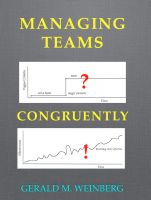 Managing Teams Congruently
Quality Software: Volume 1.1: How Software Is Built
Price:
$9.99 USD.
Why Software Gets In Trouble
Price:
$9.99 USD.
How to Observe Software Systems
Price:
$9.99 USD.
Responding to Significant Software Events
Price:
$9.99 USD.
Managing Yourself and Others
Price:
$9.99 USD.
Managing Teams Congruently
Price:
$9.99 USD.

The Aremac
by Gerald M. Weinberg
The Aremac Project
Aremac Power: Inventions at Risk
 Jigglers: Aremac A Century Later
The Aremac Project
Price:
$6.99 USD.
Aremac Power: Inventions at Risk
Price:
$6.99 USD.
Jigglers: Aremac A Century Later
Price:
$0.99 USD.
Books
What Did You Say? The Art of Giving and Receiving Feedback
by Gerald M. Weinberg
Series: Consulting Secrets, Book 3 · Software Testing, Book 3.
Price:
$9.99 USD.
Words: 49,740.
Language:
English.
Published: March 31, 2013
.
Categories:
Nonfiction » Self-improvement » Personal Growth / General, Nonfiction » Business & Economics » Skills
This brief and engaging book can be of use to anyone who has to interact with other people. How to offer feedback when asked or hired to do so. Why feedback tells more about the giver than the receiver. How feedback is distorted or resisted by the receiver's point of view and defense mechanisms. And in dozens of enjoyable vignettes, how humans have struggled to understand each others' responses.

Where There’s a Will There’s a Murder
by Gerald M. Weinberg
Series: Residue Class Mysteries, Book 2.
Price:
$6.99 USD.
Words: 75,040.
Language:
English.
Published: February 15, 2012
.
Categories:
Fiction » Mystery & detective » General, Fiction » Mystery & detective » Women Sleuths
(4.67 from 3 reviews)
What looks like an accident, sounds like an accident, and moves like an accident—is probably a murder. With a $-billion inheritance at stake, it's probably lots more than one. Enter the Residue Class, that diverse team of amateur outcast sleuths—an international team of geniuses whose social skills do not equal their skills in mathematics, computers, science, and catching murderers

The Blind Warrior
by Gerald M. Weinberg
Series: The Stringers, Book 3 · Women of Power, Book 5.
Price:
$0.99 USD.
Words: 3,160.
Language:
English.
Published: November 21, 2011
.
Categories:
Fiction » Young adult or teen » Science Fiction, Fiction » Fantasy » Contemporary
This short story captures Ember Wells learning to control her anger, so she can defend herself without using her Stringer power to incinerate her attackers.

Bi-Quinary Rescue
by Gerald M. Weinberg
Series: Software Testing, Book 9.
Price:
$0.99 USD.
Words: 7,810.
Language:
English.
Published: August 2, 2011
.
Categories:
Fiction » Science fiction » Adventure, Fiction » Science fiction » Space opera
(5.00 from 1 review)
This is the short story that inspired the novel, "Mistress of Molecules."
It shows what a little logic can do in the face of an emotional crisis.
Also contains opening chapters of "Mistress of Molecules."

Exploring Requirements 2: First Steps into Design
by Gerald M. Weinberg
Series: The Psychology of Technology, Book 3.
Price:
$9.99 USD.
Words: 43,610.
Language:
English.
Published: July 16, 2011
.
Categories:
Nonfiction » Career Guides » Architecture & Engineering
This is volume 2 of an innovative book that gives you the understanding you need to give people the solutions they want. The collaborative team of Gause and Weinberg tells how you can assure the requirements are right—before the product is designed.

Exploring Requirements 1: Quality Before Design
by Gerald M. Weinberg
Series: The Psychology of Technology, Book 2.
Price:
$9.99 USD.
Words: 42,730.
Language:
English.
Published: July 16, 2011
.
Categories:
Nonfiction » Computers & Internet » Programming, Nonfiction » Career Guides » Design
Here's an innovative book that gives you the understanding you need to give people the solutions they want. The collaborative team of Gause and Weinberg tells how you can assure the requirements are right—before the product is designed.

Roundtable on Technical Leadership
by Gerald M. Weinberg
Series: The Psychology of Technology, Book 6.
Price:
$7.99 USD.
Words: 37,300.
Language:
English.
Published: July 15, 2011
.
Categories:
Nonfiction » Computers & Internet » Programming, Nonfiction » Career Guides » Computer Science
Joined by coeditors Marie Benesh and James Bullock, consultant's consultant Gerald M. Weinberg highlights forty experts' secrets for building and sustaining a leadership role in software development.

Roundtable on Project Management
by Gerald M. Weinberg
Series: The Psychology of Technology, Book 7.
Price:
$7.99 USD.
Words: 41,310.
Language:
English.
Published: July 14, 2011
.
Categories:
Nonfiction » Computers & Internet » Programming
This book is mostly just what good project managers do. If you are looking for a source of nuggets for that nagging problem, and for a compelling story, one like the story you're living, well, this is very probably a good book for you. Any time you get stuck, reach for this book and you will be pleasantly surprised to find a similar situation about which the wayfarers have shared their wisdom.
Understanding the Professional Programmer
by Gerald M. Weinberg
Series: The Psychology of Technology, Book 8.
Price:
$9.99 USD.
Words: 59,700.
Language:
English.
Published: June 14, 2011
.
Categories:
Nonfiction » Computers & Internet » Training & certification, Nonfiction » Computers & Internet » Programming
A unique insider's view of the many ways to become a better programmer and to improve job performance.
Organized as a collection of essays about the profession of programming, the book is both provocative and readable.
Anyone interested in becoming a skilled and experienced professional in this sometimes treacherous profession will benefit from Weinberg's insights

Active Regulation: General Systems Design Principles
by Gerald M. Weinberg
Series: Systems Thinking, Book 3.
Price:
$9.99 USD.
Words: 65,660.
Language:
English.
Published: June 6, 2011
.
Categories:
Nonfiction » Computers & Internet » Security, Nonfiction » Computers & Internet » Programming
Active Regulation is Volume 3 in the General Systems Thinking series that begins with the world-wide best-selling, An Introduction to General Systems Thinking. (also available in ebook formats) That first series volume focused on the question,"Why do we see what we see?" The second and third books tackle the next question, namely "Why do things stay the same?

Passive Regulation: General Systems Design Principles
by Gerald M. Weinberg
Series: Systems Thinking, Book 2.
Price:
$9.99 USD.
Words: 61,080.
Language:
English.
Published: June 3, 2011
.
Categories:
Nonfiction » Computers & Internet » Security, Nonfiction » Computers & Internet » Computer science
Passive Regulation is Volume 2 in the General Systems Thinking series that begins with the world-wide best-selling, An Introduction to General Systems Thinking. (also available in ebook formats) That first series volume focused on the question,"Why do we see what we see?" This second books tackles the next question, namely "Why do things stay the same?"

Rethinking Systems Analysis and Design
by Gerald M. Weinberg
Series: Systems Thinking, Book 4.
Price:
$9.99 USD.
Words: 57,140.
Language:
English.
Published: June 3, 2011
.
Categories:
Nonfiction » Computers & Internet » Programming, Nonfiction » Computers & Internet » Computer science
Systems analysis and design have solved many problems, but they have also created many problems. This unique book tackles crucial analysis and design issues that are glossed over in conventional texts. It recognizes that while many problems are solved with systems analysis and design, many problems are also created.

Teaching People Teaching Dogs
by Gerald M. Weinberg
Price:
$9.99 USD.
Words: 45,450.
Language:
English.
Published: May 28, 2011
.
Categories:
Nonfiction » Education & Study Guides » Teaching
Dani Weinberg shares her deep experience as a anthropologist, organizational consultant, and especially trainer of dogs and people who train dogs.
It will be especially helpful for any animal trainer or anyone who aspires to become an animal trainer.

Change Done Well
by Gerald M. Weinberg
Series: Quality Software Managment, Book 9.
Price:
$9.99 USD.
Words: 51,610.
Language:
English.
Published: May 23, 2011
.
Categories:
Nonfiction » Computers & Internet » Programming, Nonfiction » Business & Economics » Management & human resources
CHANGE DONE WELL is the ninth volume in the highly acclaimed Quality Software series. In it, renowned author, Gerald M. Weinberg, illustrates how to create a supportive environment for improving software engineering—an environment in which your organization can realize long-lasting gains in quality and productivity by learning how to manage change.

CHANGE: Planned & Unplanned
by Gerald M. Weinberg
Series: Quality Software Managment, Book 8.
Price:
$9.99 USD.
Words: 67,920.
Language:
English.
Published: April 26, 2011
.
Categories:
Nonfiction » Computers & Internet » Programming, Nonfiction » Business & Economics » Consulting
From systems thinking to project management to technology transfer to the interaction of culture and process, this volume analyzes transformation from a broad range of perspectives, providing a breadth of awareness essential for successful management of high-quality software development.

Are Your Lights On?
by Gerald M. Weinberg
Series: Consulting Secrets, Book 6 · Software Testing, Book 2.
Price:
$6.99 USD.
Words: 24,430.
Language:
English.
Published: April 14, 2011
.
Categories:
Nonfiction » Education & Study Guides » Study guides - Interdisciplinary, Nonfiction » Business & Economics » Consulting
Whether you are a novice or a veteran, this powerful little book will make you a more effective problem solver. Anyone involved in product and systems development will appreciate this practical guide, which has become a cult classic. "...one of the funniest, yet helpful books in print. The authors do a great job in making difficulties into anecdotes while providing helpful & valuable advice"

An Introduction to General Systems Thinking
by Gerald M. Weinberg
Series: Systems Thinking, Book 1 · Software Testing, Book 4.
Price:
$9.99 USD.
Words: 92,140.
Language:
English.
Published: April 6, 2011
.
Categories:
Nonfiction » Education & Study Guides » Study guides - Interdisciplinary, Nonfiction » Computers & Internet » Computer science
For more than thirty-five years, this book has been hailed as an innovative introduction to systems theory, with applications in software development and testing, medicine, engineering, social sciences, architecture, and beyond. Used in university courses and professional seminars all over the world, the text has proven its ability to open minds and sharpen thinking.
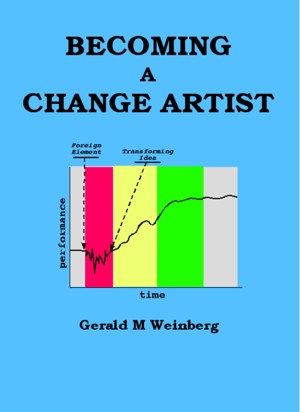
Becoming a Change Artist
by Gerald M. Weinberg
Series: Quality Software Managment, Book 7 · Consulting Secrets, Book 7.
Price:
$9.99 USD.
Words: 42,700.
Language:
English.
Published: March 15, 2011
.
Categories:
Nonfiction » Social Science » Social psychology, Nonfiction » Computers & Internet » Programming
(5.00 from 2 reviews)
In Volume 7 of the highly acclaimed Quality Software series, Gerald M. Weinberg illustrates how skilled people (Change Artists) work to create a supportive environment for software engineering —an environment in which your organization can realize long-lasting gains in quality and productivity by learning the artistry of managing change.

The Psychology of Computer Programming: Silver Anniversary eBook Edition
by Gerald M. Weinberg
Series: The Psychology of Technology, Book 1.
Price:
$9.99 USD.
Words: 126,050.
Language:
English.
Published: March 8, 2011
.
Categories:
Nonfiction » Computers & Internet » Programming, Nonfiction » Computers & Internet » Computer science
A penetrating analysis of the intelligence, skill, teamwork, and problem-solving power of the computer programmer. Topics include egoless programming, intelligence, psychological measurement, personality factors, motivation, training, social problems on large projects, problem-solving ability, programming language design, team formation, the programming environment, and much more.
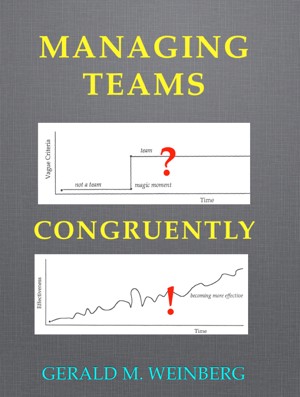
Managing Teams Congruently
by Gerald M. Weinberg
Series: Quality Software Managment, Book 6.
Price:
$9.99 USD.
Words: 48,050.
Language:
English.
Published: February 17, 2011
.
Categories:
Nonfiction » Career Guides » Computer Science, Nonfiction » Career Guides » Business Management
To be effective, team managers must act congruently. These managers must not only understand the concepts of good software engineering and effective teamwork, but also translate them into their own practices. Effective managers need to know what to do, say what they will do, and act accordingly. Their thoughts and feelings need to match their words and behaviors.

Managing Yourself and Others
by Gerald M. Weinberg
Series: Quality Software Managment, Book 5.
Price:
$9.99 USD.
Words: 56,160.
Language:
English.
Published: January 28, 2011
.
Categories:
Nonfiction » Computers & Internet » Programming, Nonfiction » Business & Economics » Management & human resources
(5.00 from 1 review)
To be effective, managers must act congruently. Managers must not only understand the concepts of good software engineering, but also translate them into their own practices. Effective managers need to know what to do, say what they will do, and act accordingly. Their thoughts and feelings need to match their words and behaviors.
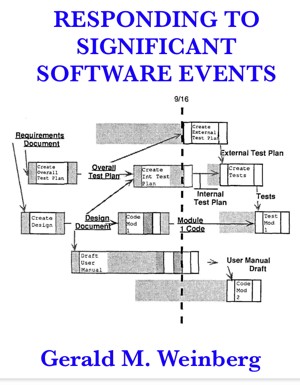
Responding to Significant Software Events
by Gerald M. Weinberg
Series: Quality Software Managment, Book 4.
Price:
$9.99 USD.
Words: 58,620.
Language:
English.
Published: January 3, 2011
.
Categories:
Nonfiction » Computers & Internet » Programming, Nonfiction » Computers & Internet » Enterprise IT management
-A software starship that has gone where no-one has gone before–N. Zvegintzov
-brimming with simple techniques & examples of their application –Computing Rev.
-required reading for anyone who cares about project success—N. Karten
-enlightening, practical, humorous, and enormously inspiring—Yourdon
-a must for all sentient software line and project managers—S/W Quality World
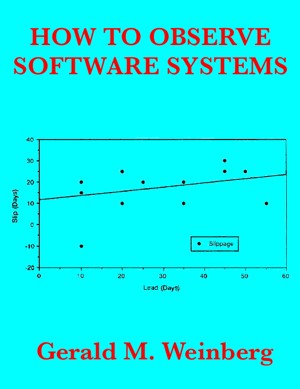
How to Observe Software Systems
by Gerald M. Weinberg
Series: Quality Software Managment, Book 3.
Price:
$9.99 USD.
Words: 53,520.
Language:
English.
Published: December 23, 2010
.
Categories:
Nonfiction » Computers & Internet » Enterprise IT management, Nonfiction » Business & Economics » Management & human resources
(5.00 from 1 review)
"This book will probably make you think twice about some decisions you currently make by reflex. That alone makes it worth reading." "Great to understand the real meaning of non linearity of human based processes and great to highlight how some easy macro indicator can give info about your s/w development process." "An incredibly useful book" - Amazon Reviews

Weinberg on Writing: The Fieldstone Method
by Gerald M. Weinberg
Series: Consulting Secrets, Book 4 · Software Testing, Book 6.
Price:
$9.99 USD.
Words: 54,230.
Language:
English.
Published: December 8, 2010
.
Categories:
Nonfiction » Publishing » Self-publishing
(5.00 from 6 reviews)
"a delight, a wise and warm book on overcoming the perils of trying to write."—Gabriele Rico, author of Writing the Natural Way
"smart, funny, memorable, wise, engaging...most important, it is all stuff that works"—Howard S. Becker, author of Writing for Social Scientists
"a gift to writers at all levels—Penny Raife Durant, award-winning author

More Secrets of Consulting
by Gerald M. Weinberg
Series: Consulting Secrets, Book 2 · Software Testing, Book 8.
Price:
$9.99 USD.
Words: 59,200.
Language:
English.
Published: December 3, 2010
.
Categories:
Nonfiction » Computers & Internet » Programming, Nonfiction » Business & Economics » Consulting
(4.50 from 2 reviews)
A sequel or extension to The Secrets of Consulting, but the two books may be read in either order. An Amazon reviewer says: "Just buy this book and improve your life. I add Mr. Weinberg to a short list of those authors and persons in my life that have made me a better person and provided some direction to the chaos of the universe."

The Secrets of Consulting
by Gerald M. Weinberg
Series: Consulting Secrets, Book 1 · Software Testing, Book 7.
Price:
$9.99 USD.
Words: 70,990.
Language:
English.
Published: November 29, 2010
.
Categories:
Nonfiction » Business & Economics » Small business & entrepreneurship, Nonfiction » Business & Economics » Consulting
(4.80 from 5 reviews)
If you are a consultant, or ever use a consultant, this book is for you. The author draws on his 50+ years of consulting experience to share his secrets about the often irrational world of consulting. "This is a great book. Period! ...this advice is clearly applicable to more than just consulting; it is applicable to life in general." "The book is truly wonderful. A must have!" - Amazon reviews

Love Poems After Fifty Years
by Gerald M. Weinberg
Price:
$0.99 USD.
Words: 7,770.
Language:
English.
Published: October 13, 2010
.
Categories:
Poetry » Biography, Fiction » Anthologies » Poetry - single author
Jerry celebrates his 50 years together with Dani in Poetry. A true love story for all ages.

Becoming a Technical Leader
by Gerald M. Weinberg
Series: The Psychology of Technology, Book 5 · Consulting Secrets, Book 5 · Software Testing, Book 5.
Price:
$9.99 USD.
Words: 78,430.
Language:
English.
Published: October 12, 2010
.
Categories:
Nonfiction » Self-improvement » Motivation & inspiration, Nonfiction » Inspiration » Personal inspiration
(4.00 from 1 review)
A personalized guide to developing the qualities that make a successful technical leader. We all possess the ingredients for leadership, some better developed than others.
The book focuses on the problem-solving style–a unique blend of skills in 3 main areas: innovation, motivation, and organization. Ways to analyze your own leadership skills, with practical steps for developing those skills.

For the Love of Harmony
by Gerald M. Weinberg
Price:
$0.99 USD.
Words: 1,840.
Language:
English.
Published: October 10, 2010
.
Categories:
Fiction » Romance » General
(5.00 from 1 review)
How two young lovers finally resolve their miscommunications.

Why Software Gets In Trouble
by Gerald M. Weinberg
Series: Quality Software Managment, Book 2.
Price:
$9.99 USD.
Words: 38,410.
Language:
English.
Published: October 2, 2010
.
Categories:
Nonfiction » Computers & Internet » Programming
(4.67 from 3 reviews)
Many books have described How Software Is Built. Indeed, that's the first title in my Quality Software Series. But why do we need an entire book to explain Why Software Gets In Trouble? Why not just say "people make mistakes"?
Why not? Because there are reasons people make mistakes, and make them repeatedly, and fail to discover and correct them. That's what this book is about.
Perfect Software and Other Illusions About Testing
by Gerald M. Weinberg
Series: The Psychology of Technology, Book 4 · Software Testing, Book 1.
Price:
$9.99 USD.
Words: 53,550.
Language:
English.
Published: September 27, 2010
.
Categories:
Nonfiction » Computers & Internet » Training & certification, Nonfiction » Computers & Internet » Programming
(5.00 from 4 reviews)
James Bach says, "Read this book and get your head straight about testing. I consider Jerry (Weinberg) to be the greatest living tester."
Answers the questions that puzzle the most people:
Why do we have to bother testing?
Why not just test everything?
What is it that makes testing so hard?
Why does testing take so long?
Is perfect software even possible?
Why can't we just accept a few bugs?

Quality Software: Volume 1.1: How Software Is Built
by Gerald M. Weinberg
Series: Quality Software Managment, Book 1.
Price:
$9.99 USD.
Words: 57,090.
Language:
English.
Published: September 26, 2010
.
Categories:
Nonfiction » Computers & Internet » Programming, Nonfiction » Computers & Internet » Enterprise IT management
This is part 1 of the latest edition of the classic, Quality Software Management. Its fundamental purpose is to teach how to understand the dynamics of software development organizations, to plan software projects, and to act effectively to carry out those plans.

Jigglers: Aremac A Century Later
by Gerald M. Weinberg
Series: The Aremac, Book 3.
Price:
$0.99 USD.
Words: 11,470.
Language:
English.
Published: August 20, 2010
.
Categories:
Fiction » Young adult or teen » Science Fiction, Fiction » Science fiction » General
Finally, after 100 years, Roger Fixman explains to his grandson the great secret of Jigglers, Inc., the company that Aremac built and the riches it made for Roger and Tess.

Earth's Endless Effort
by Gerald M. Weinberg
Series: Women of Power, Book 3.
Price:
$6.99 USD.
Words: 90,140.
Language:
English.
Published: August 16, 2010
.
Categories:
Fiction » Young adult or teen » Science Fiction, Fiction » Science fiction » Adventure
(4.83 from 6 reviews)
LAFE doesn't live in the forest. LAFE is the forest. LAFE's size and thousands of years of experience provide the wisdom to survive. When a pipeline project threatens to slice LAFE's brain, LAFE seeks the aid of Daphne DeFreest. But first they must heal her broken body and find a way to communicate. Then Daphne must find the love of her life, and they all must cope with their common enemies.

Freshman Murders
by Gerald M. Weinberg
Series: Residue Class Mysteries, Book 1.
Price:
$6.99 USD.
Words: 122,890.
Language:
English.
Published: August 14, 2010
.
Categories:
Fiction » Young adult or teen » Mystery & Detective, Fiction » Mystery & detective » Women Sleuths
(4.80 from 5 reviews)
Math Prof and former NSA problem-solver Josh Rosemont, finds a woman’s body in the woods. Rosy's team hounds a twisted trail of false clues to uncloak the Dean’s sex scandal, decipher incriminating evidence in a billion-dollar swindle, and thwart a serial killer–a deranged student who believes raping and killing a potential suicide is not really murder. But did they catch the real killer?

Mistress of Molecules
by Gerald M. Weinberg
Series: Women of Power, Book 1.
Price:
$6.99 USD.
Words: 97,540.
Language:
English.
Published: August 13, 2010
.
Categories:
Fiction » Science fiction » Adventure, Fiction » Romance » Fantasy
(5.00 from 2 reviews)
Libra has never seen a tree. On her planet, every growing thing poisons humans. Using her extraordinary powers of chemical synthesis, she terrorizes the corporations and churches that hold everyone in slavery. Across the galaxy, Andre saves a Zgaarid spaceship and is implanted with Zgaarid technology. Andre meets Libra. The reaction is explosive. The galaxy will never be the same.

The Hands of God
by Gerald M. Weinberg
Series: Women of Power, Book 2.
Price:
$6.99 USD.
Words: 67,810.
Language:
English.
Published: August 13, 2010
.
Categories:
Fiction » Young adult or teen » Social Issues, Fiction » Coming of age
(4.60 from 5 reviews)
How Would You Live If You Lost Your Hands?
Could you feed yourself? Clean yourself? What about opening a door? How would you dress yourself, or tie your shoes? Would everyone you ever loved consider you a freak? A monster?
Pamela Ruka knows the answers to these questions, and more. When she was six years old, she lost her hands in the accident that claimed her mother’s life.

Aremac Power: Inventions at Risk
by Gerald M. Weinberg
Series: The Aremac, Book 2 · Women of Power, Book 4.
Price:
$6.99 USD.
Words: 126,250.
Language:
English.
Published: August 13, 2010
.
Categories:
Fiction » Science fiction » High tech, Fiction » Thriller & suspense » General
(4.00 from 3 reviews)
Marna has a PhD in theoretical physics. So does Tess. Marna is unhappy because nobody will pay attention to her theory of quantum displacement. Tess is unhappy because everybody is paying attention to her husband's reverse camera, Aremac. Half the FBI thinks Roger has the answer to the terrorism problem. The other half thinks he's a terrorist.
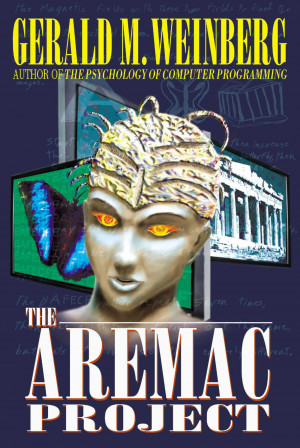
The Aremac Project
by Gerald M. Weinberg
Series: The Aremac, Book 1.
Price:
$6.99 USD.
Words: 104,630.
Language:
English.
Published: August 12, 2010
.
Categories:
Fiction » Mystery & detective » General, Fiction » Science fiction » High tech
(5.00 from 2 reviews)
Young genius Roger Fixman invents Aremac, a machine to extracts pictures from people's minds. Everyone wants to steal his invention, yet a flaw in Aremac rendered his wife Tess unable to move or communicate.
Can Roger correct the bugs and save her before her body fails? Can he prevent Aremac from falling into unscrupulous hands? Or will age and treachery triumph over youth and hope?

Second Stringers: The Sole Advantage
by Gerald M. Weinberg
Series: The Stringers, Book 2 · Women of Power, Book 7.
Price:
$6.99 USD.
Words: 105,760.
Language:
English.
Published: August 12, 2010
.
Categories:
Fiction » Science fiction » Adventure, Fiction » Science fiction » Space opera
(5.00 from 1 review)
Six young people--each born with a disfiguring and crippling defect--possess the power to access the underlying string structure of the universe and thus violate the most trusted laws of physics. They must master their personal fears and escape pursuit by those who wish to command their powers. As they discover one another, they grow in power and sophistication, becoming more fully human.

First Stringers: Eyes That Do Not See
by Gerald M. Weinberg
Series: The Stringers, Book 1 · Women of Power, Book 6.
Price:
$6.99 USD.
Words: 155,780.
Language:
English.
Published: August 12, 2010
.
Categories:
Fiction » Science fiction » General, Fiction » Science fiction » Adventure
(5.00 from 2 reviews)
What happens if the physicists' String Theory is correct, and the "real" universe is nothing more than a human mental construct?
And what happens to the half-dozen young adults who, through an accident on their common day of conception, can mentally pull the strings of the universe?
And what if each of their rule-shattering powers is accompanied by a deformity shunned by society?
Gerald M. Weinberg's tag cloud
action
adventure
adventure young adult science fiction
advice
aggregates
aikido
alien beings
alien encounter
alien intelligence
alien space craft
alien technology
aliens
aliens among us
aliens on earth
aliens romance humans
amateur sleuths
ambiguity
analysis
applied psychology
arab culture
arabs
aremac
artificial intelligence
brain
bugs
business
business advice
business consulting
business strategy
career development
change
change agents
change management
christian growth
christian help for gamblers
christian victory
church and state
college
coming of age
communication
communication between mates
communication in a relationship
communication in relationships
communication skill in negotiation
communication skills
computer
computer programming
computer scams
computers
congruence
consulting
coping with hypocrites
costs
cryptography
design
designing
diagram of effects
dog training
dogs
donald c gause
ecology
ecoterrorism
effectiveness
failures
faults
feedback
fraud
general systems
geniuses
gerald m weinberg
german shepherd dog
golden anniversary
handicaps
healthy relationships
high finance
high tech
horses
inventions
leader
leadership
leadership assessment
leadership books
leadership development
leadership skills
leadership style
legal
listening
listening skills
love after 70
love at first sight
love story
management
management information systems
managing programmers
marketing
marketing strategies
martial arts
measurement
mind reading
mistress of molecules
murder
murder and mystery
murder investigation
murder mystery
mystery
nonfiction
observing
organizational change
organizing
overcoming handicaps
performance testing
pets dogs
planning
poetry
poetry anthology
poetry from the heart
poetry of love
pricing
pricing strategies
problem definition
problem solving
process improvement
product creation
product development
product planning
professionalism
programmer
programming
project management
projects
psychology of programming
quality
quality assurance
quality management systems
regulation
relationships romance intimacy
requirements
resistance
roger fixman
romance
romance adventure
romance fantasy
romance fiction
romance short story
selfesteem
serial killer
shape
software
software cultural patterns
software development
software engineering
software quality
software testing
software testing interview
softwaresoftware cultural patternssoftware developmentsoftware testing management congruence selfesteem
sources of ideas
space
space flight
special powers
specifications
stability
strategy
string theory
stringer
success
suicide bombers
suitable for ya
systems
systems analysis
systems design
systems engineering
systems thinking
tactics
teaching
team
team building
team work
teambuilding
technical leadership
technical training
techno thriller
technology
technology management
technothriller
terrorism
terrorist
terrorist cell
terrorist lawyers
terrorists
tess myers
testing
the power of belief
thinking
thinking outside the box
thinking patterns
thriller and mystery
tools
training animals
training dogs
trees
trust
warrior
warrior path
warrior woman
women sleuths
writers block
writing a book
writing better
writing exercises
writing help
writing step by step
writing success
young adults
Gerald M. Weinberg's favorite authors on Smashwords


Jeffrey A. Carver
Latest book:
Crucible of Time: Part Two of the "Out of Time" Sequence.
Published September 10, 2019.
Published September 10, 2019.
Smashwords book reviews by Gerald M. Weinberg
-
Dory Cove
on Sep. 13, 2010
Although I'm not what would be considered a romance reader, the story of Dory Cove hooked my interest. The principal characters are lovely people–nice enough to root for them and want to read more. I knew theirs was a romance, so things would eventually work out for Penny and Davey, but I wanted to see how it would happen. The fine writing made it an enjoyable trip. Before the romance between Penny and Davey could work out, Penny had to come to accept Dory Cove life and overcome her fear of the sea. To me, this was the difficult task, and I could identify with her fears and other emotional reactions. This part of the story made it not just a simple romance (if romance is ever simple), but a compelling tale of life and death by the ocean.
-
First Impressions
on Feb. 03, 2011
For me, one trouble with short stories is they're either too long or too short. If they're not very good stories, they're too long, but if they are good, they're too short. I want a novel, at least. Maybe a trilogy, or a never-ending series. After reading Mr. DeLee's "Kickin' It South of the Border," I decided it was one of the too short variety. I simply hadn't had enough of bounty hunter, Grace deHaviland, so I bought "First Impressions." My only problem with that decision was that the two stories together are too short. I want more of Grace. So get busy, Mr. DeLee. Let's make a collection of Grace Notes—even a novel probably wouldn't satisfy me. In the meantime, you readers can at least have two fine reads, then maybe we'll both pester DeLee for a third. A fourth. A ...
-
Gabriel & Mr. Death
on Feb. 05, 2011
If you've ever faced death, or ever had a dog, you'll understand Susan Kroupa's story—as told by Gabriel, Sally Ann's black-and-tan hound. And you'll cry, as I did—tears for what was and tears for what might have been. But also tears for what is, and what is to come.
-
Night of the Aurora (Salmon Run - Book 1)
on May 14, 2011
In my long life, I've visited many countries and 49 of the 50 United States. My one significant omission is Alaska, which was always the one state I thought most worth seeing. Well, I may not manage to reach Alaska physically, but J.A. Marlow has taken me there—and on an alien spacecraft, to boot. I couldn't have asked for more of an adventure than joining the Callahan boys as the arrive in the frozen north to claim their inheritance—a "haunted" lodge in the wild, wild wilderness. I could go on with my praises, but I'm now rushing off off to read the second book in this fun adventure series.
-
Bad Agent, No Catnip! Bad Career Advice and Questionable Misinformation from the World's Worst Literary Agent, Sydney T. Cat
on Aug. 10, 2011
(no rating)
I love it, but my literary agent German Shepherds don't like Sydney giving away the secrets of our game. Of course, they don't care for cats anyway, except for desert, though they love their litter boxes. If the best way to deliver painful messages is in humor, Sydney's done the best job of revealing the pain a bad agent can inflict on a cowardly writer. Thanks, Sydney. You may not earn the rest of your fees, but $4.99 is a bargain.
-
Dead Hypocrites
on Dec. 13, 2011
I'm frequently asked to explain why I take the "easy way out," rather than fight my way through life's difficulties without the "crutch" of my religion. Well, anyone who thinks faith is the "easy way out" ought to read Dead Hypocrites. It's a brave work, confronting the issue of professing to be a Christian and yet preaching against your very own secret sins. Perhaps, as a Quaker, I take another "easy way out—by eschewing preaching altogether. Dead Hypocrites gave me plenty to think about. First, of course, it's a moving mystery, and can be read as entertainment without needing to serve any higher purpose. But at the same time, it does an extraordinary job of showing one person's struggles to retain his belief in God, in the face of a devilishly murderous world. Each of us has times when our faith is put to the test. Author Laura Ware has constructed what might be the ultimate test for her protagonist, detective Dave Hill. When you read Dead Hypocrites (and you should), you'll definitely be grateful you will never have to face this test yourself. And you'll be inspired to read how one person wrestled with his own test and ... Oh, but I'd better not give away the ending. That would be a sin.
-
Shadow Life
on Dec. 21, 2011
Some books you can't put down until you reach the end. Those are rare enough, but even more rare are the books you can never put down. Their stories stay with you for the rest of your life. You might say they live a sort of "shadow life" inside your head, becoming active when triggered alive by some scene or event. Shadow Life is such a book. Shadow Life started me thinking deeply about a number of serious issues in our modern society, such as, - The truly important things in a person's life are the same whether the person is gay, straight, bisexual, or asexual. - How a simple label, once given, can change a life forever, and never be entirely erased. - How weak a lonely individual is, and how strong he becomes when he teams up with another lonely individual. Shadow Life's writing is movingly clear, its protagonists truly alive, and its lessons unforgettable.
-
Jessica Falls
on Feb. 22, 2012
I had promised to review Terry Hayman's novel, Jessica Falls, but as the story drew me into its web, I was having trouble figuring out how to communicate with my readers. To begin with, Jessica Falls is not your usual plain vanilla mystery. I didn't know how to describe the book--until I ran across a quote from the protagonist/narrator, Weston Long. His own words pretty much told the story: "...a big part of why I was still here, now chased and threatened by gun-wielding types, was because I needed to understand what made Jessica Pollard tick. What made her who she was that she could twist me around her baby finger? What gave her that power? Or maybe it was just part of my own psychic Dumpster diving. I needed to go deep into her decadence to understand the dark patches of my own soul." I don't know how women readers will respond to this story, but as a man, I responded to virtually every page with memories of that mysterious beautiful woman who "could twist me around her baby finger." Like Wes Long, I endured beatings (both physical and psychological) as I pursued my own "Jessica." But unlike Wes, I didn't have to contend with every crime in the book: murder, embezzlement, fraud, rape, assault, drug dealing, incest, and even cruelty to animals. No, Jessica Falls is not a comfortable story, but it's one you won't be able to put down until both you and Wes have learned about "the dark patches" in your own soul.
-
Masks
on May 28, 2012
For the first few pages, E. M. Prazeman's Masks had my mind reeling—much the same feeling as culture shock. I read on, carried through my puzzlement by the luscious writing, until I realized that the feeling actually was culture shock. Young Mark Seaton, dreaming of becoming a sailor like his father, lives in a world similar to an archaic version of ours—similar but for the culture shock. For Mark, there is nothing shocking about his world—until his mother is murdered, his father disappears, and he is kidnapped and sold into a world of perverted nobles to be trained in the masked arts of seduction, treachery, and murder. Mark grows to manhood unable to escape this immensely rich, exotic world, but never quite accepting its immoral premises. When a duel kills both masked opponents, he seizes upon one of their identities and escapes to an island world in which he feels more at home. But this new world is just as beset with intrigue as the one he escaped, but now he finds himself at the conspiracy's center. His hope for a good, honest life is not yet to be fulfilled. To save his new home, he must return to the one from which he escaped. Luckily for the delighted readers of Mask, Mark's adventures will be continued in Confidante, Book Two of The Lord Jester's Legacy.
-
Exotics #2: Xanadu House
on June 25, 2012
As an adult, I'm not supposed to admit that I enjoyed reading a book for younger readers. But as a grandfather, it's okay for me to tell how much my grandkids will enjoy De Kenyon's book, Xanadu House. Xanadu House is Book 2 of The Exotics, and it's a bit hard to get started if you haven't read Book 1 (a problem which is readily solved). A bit hard, that is, if you're an adult with the adult kind of mind that insists on every question having a logical answer. On the other hand, Xanadu House has all the kinds of things kids love--as the cover promises, spies and magic. Plus likeable kids galore, and hateable ones, too. And mysterious characters doing incredible things. The Exotics are shape-shifters, each one having an animal side to call upon, sometimes intentionally and sometime by accident. Rachel's mom turns into a bee. Her friend, Babra, a cute cocker spaniel. Digger is a mole, and Rachel, our heroine, discovers her alter-ego is a gecko. Her gecko-form allows her to walk on ceilings and slip through small spaces so she can escape traps and also spy on plotting adults and kids. Xanadu House is a refuge for exotics, but in this sparkling adventure, there's really no place to hide that's entirely safe. That's just another reason kids will love the book.
-
Naero's Run
on April 30, 2013
It was with some trepidation that I began to read Naero's Run. It is well and truly a space opera, and over the years, I've become more demanding of space operas. They're like the little girl with the curl: When they're good, they're very very good, but when they're bad, they're horrid. Well, much to my delight, Naero's Run is one of the good ones. It has all the usual fantastic tech, plus some original stuff to spice up a fast-moving story. To top it off, I fell in love with Naero, as she made her run to save the galaxy from unspeakable tyrants. It's pure entertainment, and that's exactly what I want my space opera's to be. As a bonus, the story raises some important philosophical questions, but doesn't slow down a bit for them. If you're a fan, you'll be pleased you read Naero's Run.